
Introduction
What happens to a claims operation when the manipulated photo comes from an ordinary policyholder instead of a fraud ring? Verisk's 2026 fraud study found that 55% of Gen Z consumers and 49% of millennials would make a small rule-bending edit to a claim photo or document, and Aviva stopped £233 million of suspected claims fraud last year with a growing share of it built on AI-generated images and manipulated paperwork.
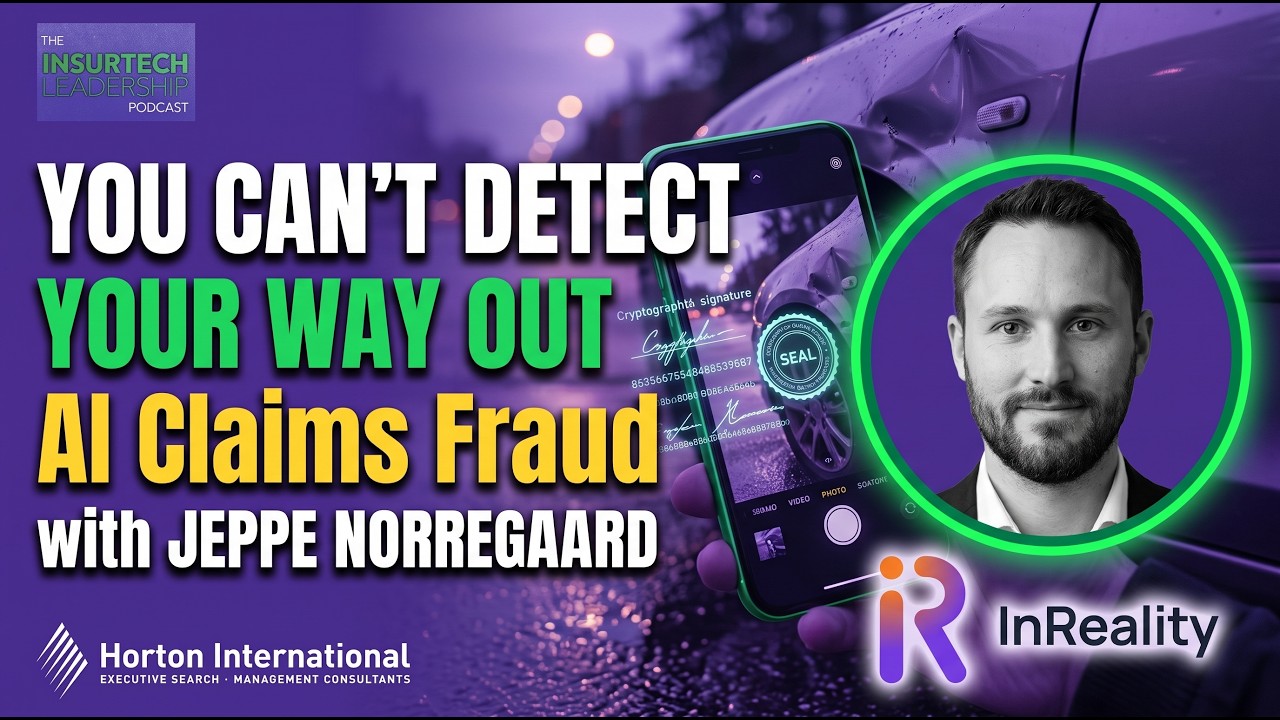
Jeppe Nørregaard spent seven years building AI systems to detect fake content before deciding the detectors were going to lose. He now runs a company built on the opposite bet, which is that you protect real content instead of chasing fake content. In this episode he walks host Joshua R. Hollander through why detection breaks down under generative AI, what signing content at the point of capture actually asks a carrier to change, and why a flat fraud number next year should worry a claims leader rather than reassure them.
Guest Bio
Jeppe Nørregaard is co-founder of InReality, a Copenhagen company that cryptographically signs photos, video, and documents at the moment they are captured so whoever receives them can prove the content is real and unaltered. He holds a PhD from the Technical University of Denmark, where he worked on AI and misinformation, and his research on how fake news detection degrades over time and under attack is among his most cited work. He did a research stay with an American research group in upstate New York studying AI for misinformation detection, and he sat alongside the researchers building deepfakes while he was building the detectors. InReality works today with news organizations and insurers, and is backed by the Deloitte Innovation Accelerator, the IBC Accelerator, and Antler.
Key Topics
-Why detection loses the arms race - Across seven years of research, Jeppe watched AI strengthen the attacker faster than it strengthened the defender, first with bots and automation and then with deepfakes.
-Flipping the problem - InReality does not evaluate fake content at all. It builds cryptographic guarantees around real content and treats everything outside that pipeline the way the internet already works.
-What a flat fraud number actually means - If detected fraud stops climbing while deepfake use keeps rising, the likelier explanation is that carriers have stopped seeing it rather than that it stopped happening.
-Where signing happens inside a claim - The policyholder photographs the damage through the carrier's own app, and the security sits inside that capture rather than as a review step afterward.
-Cryptography instead of prediction - Detection produces false positives because it is a prediction system. A signature either verifies or it does not, and InReality uses post-quantum signatures.
-Why they refused to build on a blockchain - A blockchain proof cannot be removed, which collides with GDPR's right to be forgotten, so they built an alternative way to produce the same cryptographic proofs.
-What to do with a detection budget already spent - Jeppe separates deepfake detection, which he would stop funding, from the rest of the AI claims stack, which he says carriers should keep investing in.
Notable Quotes
"We don't actually deal with fake content at all in our company. We completely ignore fake content. Instead, we build security guarantees for real content."
"I sat next to the guys who did deepfakes. They tried to deepfake Barack Obama, and I tried to find misinformation. So I knew where this was headed."
"A lot of money has gone into deepfake detection, and fundamentally we believe that it was a mistake, but it's a mistake that everyone made across the planet."
"If we start to see a flattening or a decrease in the amount of fraud that we find, then I would say we have a real problem, because it most likely means that we don't catch it."
Resources
Guest:
InReality: https://inreality.io/
Jeppe Nørregaard on LinkedIn: https://www.linkedin.com/in/jeppe-n%C3%B8rregaard/
Host & Organization:
Joshua R. Hollander on LinkedIn: https://www.linkedin.com/in/joshuarhollander/
Horton International (USA): https://www.horton-usa.com/
Insurtech Leadership Podcast (LinkedIn Showcase): https://www.linkedin.com/showcase/insurtech-leadership-show
Subscribe & Review
If you enjoyed this episode, subscribe on your favorite platform and leave a review. The Insurtech Leadership Podcast is available on YouTube, Podbean, Apple Podcasts, and Spotify.