
Introduction
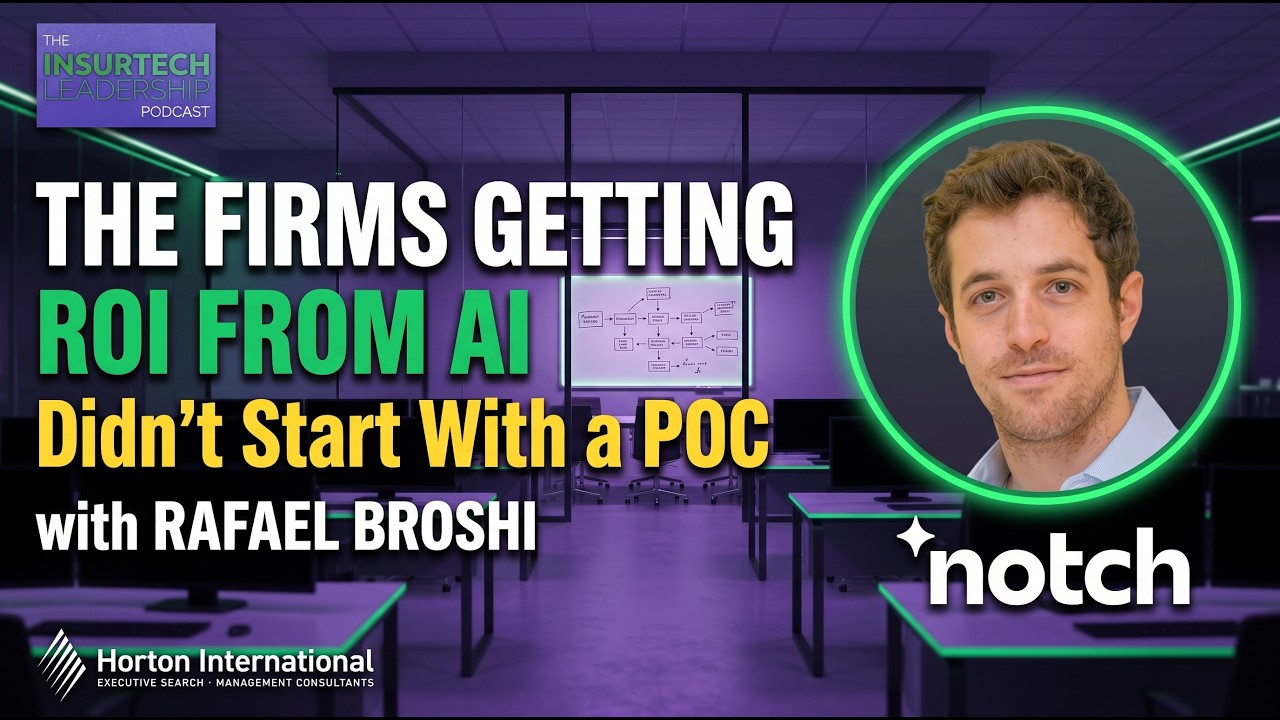
What happens to a company that has run two hundred proofs of concept and still cannot point to one that paid for itself? Rafael Broshi says that is roughly where financial services sits after two years of generative AI experimentation, and he does not think the models are the reason.
Broshi has an unusual vantage point on this. He built a brand new insurance product, took it to the admitted market, watched it fail to find buyers, and rebuilt his company around the software his team had written to run it. In this episode he walks host Joshua R. Hollander through why demos survive and production launches do not, what has to be written down before a process can be automated at all, and where an AI agent should never be allowed to improvise.
Guest Bio
Rafael Broshi is co-founder and CEO of Notch, an AI platform for building and deploying agents inside highly regulated industries. He spent nearly ten years in the Israeli military, as did both of his co-founders, and the three of them started Notch about five years ago as something else entirely: a specialty product insuring digital assets including crypto and social media accounts, launched in the admitted market across 47 states with Hartford Steam Boiler. That product did not find a market. The platform the team built to run their own MGA became the company. Notch now deploys agents across customer experience, claims intake, document ingestion, and underwriting workflows for insurers, banks, and asset managers, and is backed by Lightspeed, Jibe Ventures, Munich Re Ventures, and Phoenix.
Key Topics
-Why a new insurance product is the wrong startup bet - Cyber insurance launched in 1997 and took until roughly 2015 to catch on, and no startup survives an eighteen year runway regardless of how much it raises.
-Innovate on distribution, not on the product - Broshi argues that the insurtechs that generated real returns over the past decade changed how insurance was sold rather than inventing new coverage.
-What happens between a working POC and a failed launch - Agents are non-deterministic, so they break as knowledge, guardrails, and process complexity scale, and by the time a project reaches that point its trajectory is easy to change.
-Why he does not believe in forward deployed engineers - He calls the FDE model system integration under a new name, and asks what happens at use case number two hundred inside a five thousand person carrier.
-Why breaking down the process is the part that actually fails - He ties the 75% digital transformation failure rate to the difficulty of mapping a process across departments, and describes AI agents as RPA 7.0 with the same underlying requirement.
-Where agents stay probabilistic and where they must not - Empathy in a first notice of loss conversation cannot be scripted, but the order of the fifteen intake questions cannot be left to a model.
-The subagent architecture behind auditability - Fifteen to twenty subagents run concurrently in a single conversation, each owning one question, so no action happens without a model that can explain it.
-What disqualifies a process entirely - No API access to the data, prediction problems that belong to older machine learning, and any process with no written SOP.
Notable Quotes
"With Gen AI it's extremely easy to show a demo and to show something working in a POC, but when it reaches production, things go south extremely fast."
"Launching a new agent is a business transformation to a specific department. And it's an HR problem as much as it's an IT problem."
"The scars that you now carry on your back, those are your only assets that are worthwhile."
"Everyone says they're doing AI. Don't choose vendors according to presentations. Always do multi-vendor POCs."
Resources
Guest:
Notch: https://www.notch.cx/
Rafael Broshi on LinkedIn: https://www.linkedin.com/in/rafael-broshi-435a77105/
Notch on LinkedIn: https://www.linkedin.com/company/notchapp/
Host & Organization:
Joshua R. Hollander on LinkedIn: https://www.linkedin.com/in/joshuarhollander/
Horton International (USA): https://www.horton-usa.com/
Insurtech Leadership Podcast (LinkedIn Showcase): https://www.linkedin.com/showcase/insurtech-leadership-show
Subscribe & Review
If you enjoyed this episode, subscribe on your favorite platform and leave a review. The Insurtech Leadership Podcast is available on YouTube, Podbean, Apple Podcasts, and Spotify.