
Introduction
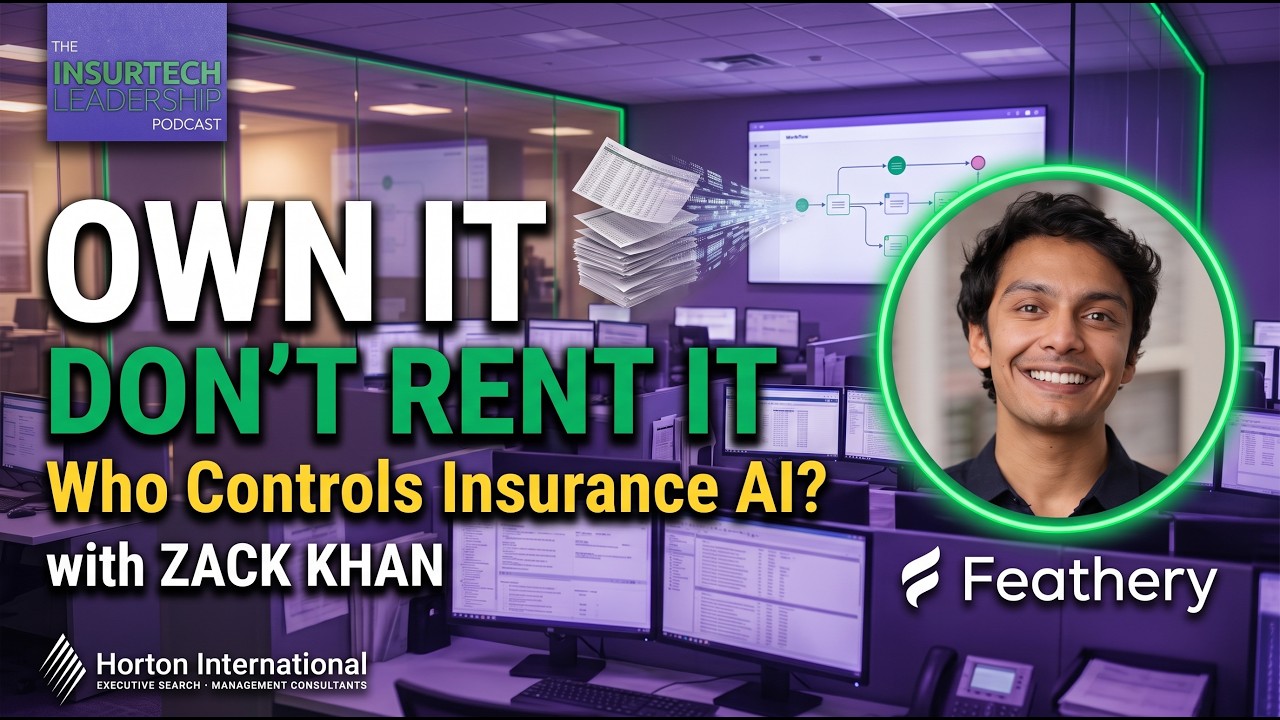
What does an insurer actually own after a few years of buying AI one use case at a time? Feathery co-founder Zack Khan argues that the answer decides whether AI ever produces more than incremental gains, because a workflow you cannot change without filing a vendor ticket is a workflow you are renting. Fresh off a $30 million round led by Portage, with Allstate and Erie both in as strategic investors, Khan walks host Joshua R. Hollander through what it takes to put workflow control in the hands of the operating teams themselves.
Guest Bio
Zack Khan is Co-Founder of Feathery, the AI operating and decisioning system for financial services. He started as a software engineer building complex forms at Robinhood and Nextdoor alongside co-founder Peter Dun, then became the fifth employee at Hightouch, where he led marketing as the company grew toward a $3 billion valuation. Khan and Dun founded Feathery in 2021 as a developer-focused form builder and grew it into a platform that now serves more than 300 firms, including Tokio Marine, Hiscox, Baldwin Group, and Hylant, orchestrating submission intake, virtual inspections, quoting, and benefits workflows across carriers, MGAs, and brokers. Feathery ran profitably before raising its $30 million round in July 2026.
Key Topics
-Vendor-led vs. team-owned workflows - Why the last generation of insurance software put every change behind a vendor ticket, and what changes when underwriting and operations teams define workflows in natural language instead.
-Copilot licenses vs. step changes - Giving everyone a copilot produces small gains; redefining one workflow end to end took a carrier from an eight-hour time to quote down to fifteen minutes.
-Orchestrate rather than replace - Feathery's agent, Robin, works across existing rating engines, AMSs, and even legacy desktop applications, automating the data entry instead of ripping out the system.
-Rules where you want them, judgment where you need it - Deterministic guardrails handle rating inputs, while objective-driven agents handle tasks like checking a virtual inspection for a pool or a tree touching the roof.
-The Baldwin Group benefits example - Custom employee benefit guides that took 20 to 30 or more hours to build now generate in minutes, across 10 to 15 assets and multiple languages, and the team's hours moved to consultative work.
-What a platform actually is - Khan's test is control: if you cannot apply your own business logic to your own workflow without a vendor ticket, you bought a point solution.
-Start in specialty lines - Fast-growing lines with less tech debt and less red tape are where AI transformation finds its first champions inside a large carrier.
Notable Quotes
"An actual platform gives you control. If you don't have fundamental control over the actual experience, and you're applying your own firm-specific business logic to your workflow, that is a point solution."
"If your rating engine is working great, it's just the annoying part is typing data into it. You don't rip out the whole rating engine; you just automate the data entry part of it."
"Some of our customers have gone from an eight-hour time to quote to less than fifteen minutes responding to producers. That's the stuff that actually will impact your bind ratio."
"For AI to truly have the impact you want, you need to redefine the workflow, think about the end-to-end ideal process that you want your best underwriter, your best claims adjuster, your best producer to be following."
Resources
Guest:
Feathery: https://www.feathery.io/
Zack Khan on LinkedIn: https://www.linkedin.com/in/zackkhan101/
Host & Organization:
Joshua R. Hollander on LinkedIn: https://www.linkedin.com/in/joshuarhollander/
Horton International (USA): https://www.horton-usa.com/
Insurtech Leadership Podcast (LinkedIn Showcase): https://www.linkedin.com/showcase/insurtech-leadership-show
Subscribe & Review
If you enjoyed this episode, subscribe on your favorite platform and leave a review. The Insurtech Leadership Podcast is available on YouTube, Podbean, Apple Podcasts, and Spotify.