
Introduction
Most workers comp MGUs offer the same coverage at a slightly different price. Kinetic started with a wearable device clipped to a warehouse worker's waistband and built an entire MGU around the insight that technology can prevent the injury before it becomes a claim, manage the claim better when it does happen, and price the risk more accurately throughout.
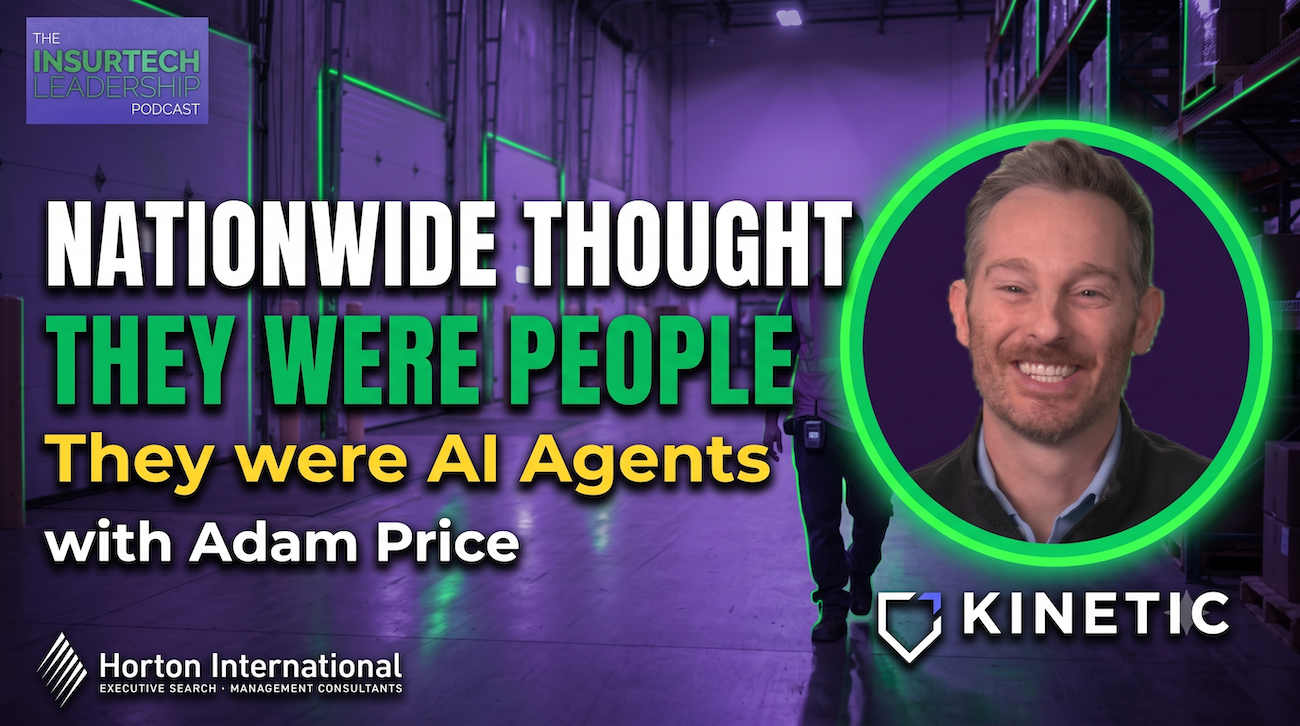
Adam Price is the CEO of Kinetic, a monoline workers comp MGU that sits between capacity providers and retail brokers, using technology across prediction, prevention, and claims management to deliver outcomes no standard policy can match. What started as a hardware company leasing devices to self-insured giants like UPS and Amazon has grown into an MGU approaching ninety million dollars in premium in just three and a half years, backed by Nationwide Mutual as its primary capacity provider. In this conversation, Josh Hollander and Price dig into how Kinetic made the pivot, what it took to convince investors, and where AI is already running live in the claims process.
Guest Bio
Adam Price is the CEO of Kinetic, a technology-centric workers comp MGU based in New York. He joined Kinetic in 2020 as a consultant before becoming COO and then CEO, bringing a background that includes founding and selling a logistics software company and subsequently leading as CEO of the publicly traded acquirer. Kinetic was founded by engineers Hatem and Aditya, who developed a wearable device to prevent musculoskeletal injuries in frontline workers, and has since evolved into a full-stack MGU with a proprietary platform integrating into Guidewire Claim Center for real-time claims management.
Key Topics
From wearables to MGU: the pivot that changed everything
Kinetic spent its first six years leasing wearable devices to large self-insured employers like UPS, Home Depot, and Amazon. The device worked. The market was too small. When Price joined in 2020, the team made the decision to embed the product inside a workers comp policy rather than sell it as a standalone hardware subscription. That pivot turned Kinetic from a niche device company into a monoline MGU, and within twelve months of writing its first premium they went from zero to twenty-five million dollars. They are now approaching ninety million.
Why high-frequency, lower-severity is the sweet spot
Kinetic does not chase severity-style claims. It focuses on high-frequency, lower-severity industries where strain and sprain injuries from improper lifting and repetitive movement drive loss costs. The target premium threshold is two hundred thousand dollars or higher annually, where the business owner has enough skin in the game to care about long-term premium control, not just the lowest quote available this renewal.
No silver bullet: the move to a full technology suite
Six months into writing insurance, Kinetic realized the wearable device alone could not address every injury type it was now insuring. The team expanded from a single point solution into a three-part technology framework covering prediction, prevention, and claims management. Claims management has since become the primary focus and the clearest differentiator: software that integrates with Nationwide Mutual's Guidewire Claim Center and identifies next best actions in real time rather than waiting for the annual review cycle.
What AI actually does inside a claims operation
Kinetic uses off-the-shelf LLMs, not custom models. The most impactful application is processing free-form adjuster notes at scale, something that would require an army of people to do manually. The AI reads those notes, distills them into actionable summaries, and feeds next best actions back to the operations team. Kinetic also runs named AI agents that reach out to adjusters for follow-up information, so effectively that Nationwide Mutual initially assumed Kinetic had hired several new employees to handle the outreach.
The org chart is already human plus agent
Price does not frame this as a future possibility. Kinetic is already running AI agents with names that interact with adjusters, policyholders, and brokers as part of daily operations. The team that manages those agents sits on the product side. The principle: every claim should be managed as if a single experienced senior adjuster were working that file exclusively, regardless of how many files the actual adjuster is handling simultaneously.
Broker strategy: quality over volume
Kinetic does not maintain a list of five thousand broker appointments. It targets established retail brokers with books of one hundred million or more who operate as true risk consultants rather than quoting shops. At the premium thresholds Kinetic targets, the buyer has already experienced the cost of poor claims management. That shared history makes the value conversation much easier than trying to educate a broker who has never seen a claim come in at that size.
Convincing tech investors to fund an insurance pivot
Kinetic's original investors came from a pure technology background and had invested in the wearable thesis. When Price and the co-founders decided to pivot to an MGU structure in 2020, the education required was significant. The turning point was bringing on Manchester Story, an Iowa-based firm with deep insurance investing experience, as a lead investor in a concurrent round, along with independent board members from insurance and insurtech. Once Kinetic hit twenty-five million in premium in year one, the remaining skepticism largely dissolved.
Notable Quotes
"A lot of brokers will just tell you, comp is comp. It's the same coverage, so you should just buy based on price. But at the premium levels we focus on, service is a key component of how these buyers are evaluating the product."
"We're just managing every claim as if a single, very experienced adjuster were working that file. Instead of what really happens, which is a whole swath of experience levels handling hundreds of files at the same time."
"The AI's best impact for us is we can look at those free form notes from an adjuster and distill that down into actionable insight."
"We actually had to tell Nationwide Mutual, hey, these are AI agents. They were treating our agents like people. They thought we had hired four or five additional employees."
"If you want to become the best people manager in the world, go run a restaurant."
Resources
Guest:
Kinetic: https://www.kinetic.com
Adam Price on LinkedIn: https://www.linkedin.com/in/adamjprice/
Host and Organization:
Joshua R. Hollander on LinkedIn: https://www.linkedin.com/in/joshuarhollander/
Horton International (USA): https://www.horton-usa.com/
Insurtech Leadership Podcast: https://www.linkedin.com/showcase/insurtech-leadership-show
Subscribe and Review
If you enjoyed this episode, subscribe on your favorite platform and leave a review. The Insurtech Leadership Podcast is available on YouTube, Apple Podcasts, and Spotify.