
Introduction
Insurance carriers spend enormous resources building and updating software. But when something breaks in production, finding the root cause - whether it's a data error in an XML file, a mismatch between an application and an underwriting system, or a workflow that behaves differently than expected - can take weeks. Sashia Godet has spent her career building the tools that catch those problems before they reach the customer.
Godet is the VP of Product at EmTech Group, a software development company focused on QA testing for the insurance industry. EmTech's flagship product, QMT, uses model-based testing to automatically generate test cases from business workflows - a fundamentally different approach from the script-based testing most carriers rely on. In this conversation, Josh Hollander and Godet dig into how QMT was built from a live carrier engagement, what the hardest part of product development really is, and where AI fits into the future of QA in insurance.
Guest Bio
Sashia Godet is the VP of Product at EmTech Group, where she has been with the company since its inception. She spent a decade in capital markets building compliance and regulatory solutions before transitioning into the insurance technology space. At EmTech, she leads product development for QMT, the company's model-based QA testing platform for insurance carriers and insurtechs, and is responsible for driving the product roadmap, cross-functional delivery, and market expansion.
Key Topics
Model-based testing: a different approach to QA
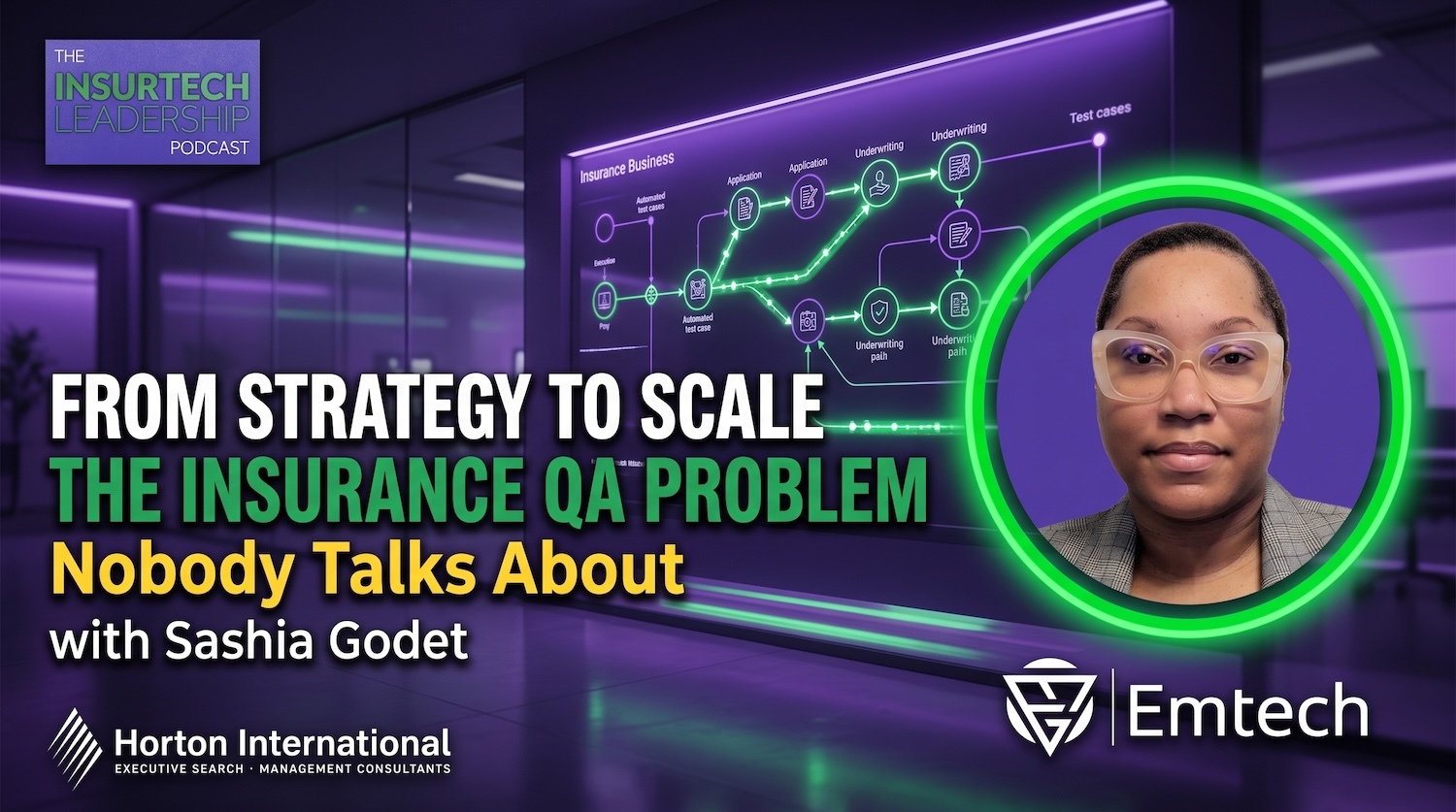
Most QA solutions for insurance rely on test scripts that have to be manually rewritten every time a workflow changes. QMT takes a different approach: the user defines the business workflow as a visual model - agent logs in, opens an illustration, fills an e-application, moves through underwriting - and QMT automatically generates the test cases in the background. The user never writes a test script. They define the process, and the platform handles the rest.
Built from a live carrier engagement, not a whiteboard
EmTech did not start with market research surveys. The original version of QMT was built alongside a large carrier whose pain points were visible in real time. When the team took that solution to market and validated it with other carriers and insurtechs, they found the same problems everywhere. That live research advantage gave EmTech a product that was already calibrated to real operational needs rather than theoretical ones.
Faster time to market is the core value proposition
The primary benefit carriers report is speed. By eliminating the time spent building and maintaining test scripts, development teams can get test cases faster, execute them sooner, find issues earlier in the cycle, and ship to production without the bottleneck that manual QA creates. For insurtechs building products for multiple carrier clients - each requiring individual customization and testing - the volume reduction is even more significant.
The hardest part of product development is the how, not the what
Godet is candid about where product teams most often stumble: not in identifying requirements, but in the technical implementation. Architecture that doesn't support a new feature, compatibility issues that surface mid-development, or requirements that shift while the product is still being built - these are the failure points that extend timelines and force teams back to the drawing board. Her advice is to spend more time in the requirements and technical design phases before writing a line of code.
XML and PDF validation added from direct customer feedback
Two significant QMT enhancements came directly from market conversations rather than internal roadmap planning. XML validation - checking that data moving between an application and an underwriting system is accurate before it reaches underwriting - was added after carriers identified rising not-in-good-order rates driven by data errors. PDF validation was added to replace the manual process of visually comparing two PDFs side by side, a task that provided limited coverage and was prone to human error.
AI in QA: the augmentation model, not full automation
EmTech introduced AI into QMT and is building toward agentic AI capabilities. Godet's philosophy is human in the loop: AI handles the volume and automation, but humans retain validation checkpoints where they can approve or reject AI-generated outputs. In a highly regulated industry where carriers are risk-averse and still exploring how to incorporate AI into their existing infrastructure, the augmentation model has generated better adoption than pitching full automation.
The product manager's most valuable skill: thinking in what-ifs
Godet's core lesson from years of product releases is the discipline of thinking through failure scenarios before launch - not just how the product is supposed to work, but what happens when a user does something unexpected. Carriers are never guided through a product with someone watching over their shoulder. They will interact with it in ways the product team never anticipated, and a well-built product handles those scenarios gracefully rather than crashing.
Notable Quotes
"The user isn't actually creating test cases or creating test scripts. Their focus is on just defining their business process in our software, and then we take care of the test cases and the execution on the backend."
"The key principle I follow in product management is always keeping your ear to the ground, making sure that your product is a fit for what customers need today."
"Software is never complete, as I like to say. But there is a minimum viable product that is really your threshold for do we release this version or we don't."
"We want to help you use AI, but human in the loop. So you have points of validation that you can say, yes, I want to use this - or no, I don't."
"I always think about what if someone does something else - because we're never sitting at our customer's screen watching what they're doing. We give them guidance, but they can do it in a completely different order."
Resources
Guest:
EmTech Group: (verify and add URL)
Sashia Godet on LinkedIn: https://www.linkedin.com/in/sashia-godet-2107931a/
Host and Organization:
Joshua R. Hollander on LinkedIn: https://www.linkedin.com/in/joshuarhollander/
Horton International (USA): https://www.horton-usa.com/
Insurtech Leadership Podcast: https://www.linkedin.com/showcase/insurtech-leadership-show
Subscribe and Review
If you enjoyed this episode, subscribe on your favorite platform and leave a review. The Insurtech Leadership Podcast is available on YouTube, Apple Podcasts, and Spotify.