
Introduction
Every insurance transaction ends in a document. An application, an accord form, a policy binder, a renewal packet. The data collection happens digitally now, but the moment it has to go into a PDF or get routed for signature, most brokers and MGAs fall back to manual entry, email attachments, and copy-paste. Mang-Git Ng built Anvil to be the infrastructure layer that sits between the data and the document.
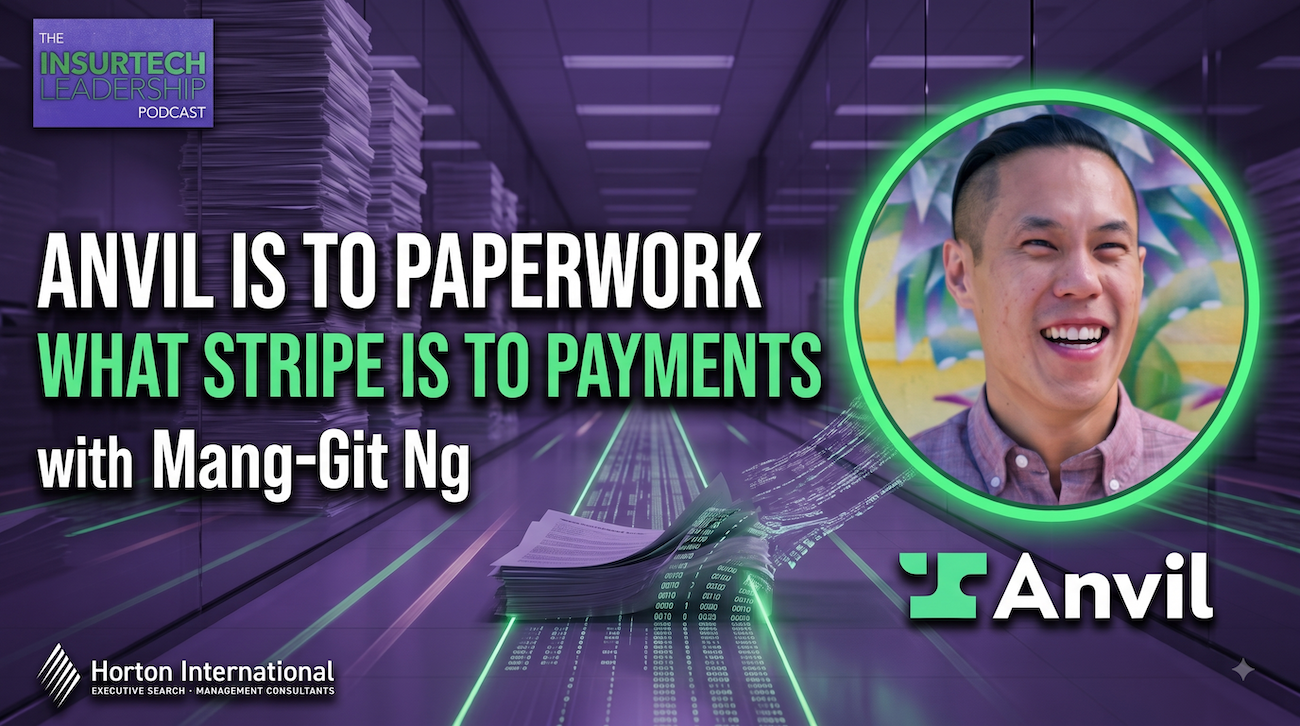
Anvil is a paperwork automation platform that serves insurtechs, tech-forward brokerages, and MGAs with a PDF filling API, embeddable e-signatures, and no-code workflow tools that turn complex multi-document processes into a guided digital experience. The company started industry-agnostic and found insurance by accident - when insurtech companies started signing up in volume and one neighbor at a WeWork desk turned out to be a Vouch Insurance founder. In this conversation, Josh Hollander and Ng dig into where Anvil fits in the insurance stack, why specialty lines are the sweet spot, and what the founder path looks like when you grow up in Michigan and end up building a document infrastructure company in the Bay Area.
Guest Bio
Mang-Git Ng is the founder and CEO of Anvil, a paperwork automation platform serving insurtechs, brokers, MGAs, and organizations across fintech, HR, real estate, and government. Before founding Anvil, he worked at Flexport and Dropbox, both of which gave him early exposure to document-heavy workflows at scale. He began his career at Cisco before cold-emailing his way into an early-stage startup founded by the creator of Google Voice, which set him on the path toward founding his own company. Anvil's e-signature product is free with no limits on documents or signers, and the company monetizes on deep integration and workflow automation.
Key Topics
Anvil is the inverse of most document tools
Most document automation tools focus on data extraction - reading what is already on a page. Anvil works the other direction: it takes data you already have and puts it into the document. A PDF filling API lets insurtech engineering teams make a single request and receive a fully populated document back. The templating process uses computer vision and LLMs to find empty fields, label them, and map them to a client's existing data schema automatically.
TurboTax for any set of insurance documents
Anvil's workflow product lets brokers and MGAs upload an entire package of forms, tag them once, and present clients with a single guided web form that dynamically routes responses, applies conditional logic, populates all the underlying documents, and routes them for e-signature. The output is a completed, submittable document package - without requiring clients to touch a PDF.
The ACORD wake-up call
Anvil launched without any insurance focus. When insurtech companies started signing up organically, Ng's team quickly learned that insurance paperwork is in a different category of complexity. The ACORD 101 overflow form - which functions as a catch-all for half a dozen other forms and has repeating page logic baked in - was the moment the team realized insurance forms would require serious investment to handle properly. They solved it, and ACORDs are now routine. Specialty lines, where there are standardized forms but no standardized process, remain the core target.
Brokers and MGAs over carriers
Carriers, Ng notes, are not incentivized to modernize their document processes. They make money on investment income from float, not on policy issuance efficiency. The parties with real motivation to speed up and clean up the paperwork layer are brokers and MGAs - especially tech-forward ones who already have software teams and data infrastructure but need the document layer to stop being a bottleneck.
E-signatures are free. Integration is the business.
Anvil made unlimited e-signatures free to use - no cap on documents, no cap on signers. The revenue model kicks in when a company decides to deeply integrate Anvil into their product or operations. Ng frames it directly: Anvil is to paperwork what Stripe is to payments. The infrastructure handles the complexity so engineering teams can focus on their core product.
Founder lessons: block the noise, hire for chaos tolerance
Ng's most consistent advice for founders is to focus inward rather than getting distracted by competitor announcements or fundraising headlines. On hiring, he describes actively talking candidates out of the job at the offer stage - describing the uncertainty, the workload, and the pressure - and treating continued enthusiasm after that conversation as the real hiring signal. On leadership, he is candid about being stubborn and working to create space for pushback rather than winning every argument in the room.
Notable Quotes
"We are in the paperwork preparation, signature completion space. We get compared to DocuSign, but we really do so much more."
"We use AI and computer vision to automatically extract fields that need to be filled out and tag and label them so they can be used in your computer program."
"We're the service to process paperwork. Stripe is the service to process payments."
"Every company that starts as a platform dies as a platform. The customer doesn't want a platform. They want you to solve a problem or a process for them."
"When I hire somebody, at the closing stage, what I'm trying to do is talk them out of taking the job. If they're still excited by the chaos, they're probably the right fit."
"Startups are not a democracy. If we were a democracy, we'd move way too slowly."
Resources
Guest:
Anvil: https://www.useanvil.com
Mang-Git Ng: https://www.linkedin.com/in/manggit/
Host and Organization:
Joshua R. Hollander on LinkedIn: https://www.linkedin.com/in/joshuarhollander/
Horton International (USA): https://www.horton-usa.com/
Insurtech Leadership Podcast: https://www.linkedin.com/showcase/insurtech-leadership-show
Subscribe and Review
If you enjoyed this episode, subscribe on your favorite platform and leave a review. The Insurtech Leadership Podcast is available on YouTube, Apple Podcasts, and Spotify.